What’s The Difference between New Abstracts and Continuation Abstracts?

When there are real estate transactions, it is helpful to be knowledgeable about the chain of title. Abstracts of the title come into play here. Suppose you are a seller, homebuyer, lender, or title professional. In that case, you can save time, money, and confusion at closing if you are knowledgeable about the difference between new abstracts and continuation abstracts.

At Abstracts of McIntosh County, Inc., we have guided numerous clients to fulfil their title requirements confidently. Below, we explain the primary distinctions between these two kinds of abstracts—and why they matter to your property transaction.

What Is The Abstract Of The Title?

An abstract of title is a concise summary of the public records relating to a particular piece of real property and includes:

  • Pre-existing evidence of ownership (chain of title)
  • Mortgages and liens
  • Rights of way and easements
  • Tax issues or choices
  • Any legal problems that affect the property.

Briefly, the abstract is a history of the property legally. It is used by lawyers, title companies, and property buyers to ensure that the title is clear and can be transferred with no issues.

What Is A New Abstract?

A new abstract is an entirely new document prepared when there is no existing abstract, or the original abstract no longer exists, has been lost or destroyed, or was never prepared. It is prepared from the local land records.

When You Might Need a New Abstract:

  • New Construction: The land has been divided into smaller parts recently or has never been sold like this before.
  • Lost or Missing Abstract: The original document is not available or was destroyed.
  • Old Abstract Is Often Outdated: An old abstract can be outdated or incomplete in such a manner that it is better to prepare a new one.

What It Has:

  • A complete history of the property
  • All previous deals from the original government patent or earliest documents.
  • Public documents filed with the county recorder’s office

Why It Matters:

New abstracts require much research and time. A title abstractor expert will have to locate every legal document about the property since it began. This is usually more time-consuming and expensive than a continuation.

What Is A Continuation Abstract?

A continuation abstract is a follow-up to an already established abstract. Rather than creating a whole new document, it picks up from where the previous abstract left off, recounting all the updates from the last certification date.

When You May Require a Continuation Abstract:

  • Resale of a House: The house has been resold previously and has an existing abstract.
  • Refinancing: To ensure that no new liens or claims have been recorded since the previous deal.
  • Title Update: For Legal or Estate Planning Use.

What It Has:

  • Events since the previous date of the above abstract
  • New home loans, releases, judgments, claims, or transfers
  • Any recent change in ownership or legal status

Why It Matters:

Continuations are faster and cheaper than new abstracts. Provided the original abstract still exists and has been brought up to some point in the recent past, a continuation enables purchasers and lenders to check the legal standing of the property without retracing the whole history.

Overall Differences at a Glance

Feature New Abstract Continuation Abstract
Basis Created from scratch Based on existing abstract
Timeframe Covers full title history Covers only since last update
Use Case New property, lost abstract, very old Resale, refinance, recent transactions
Cost Expensive due to extensive research Less expensive, quicker to produce
Documentation Required Full record search Records only since last certified date

Which One Do You Need?

This will depend on the status of the current abstract. If the abstract does exist and is current, then ordinarily, a continuation shall be adequate. But if there is no paper or if the past paper is highly outdated, then starting anew with a new abstract may be the requirement.

Your real estate agent, attorney, or lender can guide you toward which one to use—but so can local title abstract professionals (that’s us!).

Why Accurate Abstracting Matters?

Both abstract types carry the same primary obligation: to protect all parties to an existing real estate transaction. Errors, omitted information, or incomplete facts in the title history can create serious legal and cash issues. An accurately prepared abstract ensures:

  • Smooth transfer of ownership
  • Clear legal comprehension and sense of security.
  • Compliance with title insurer and lender requirements

Trust Abstracts of McIntosh County, Inc.

At Abstracts of McIntosh County, Inc., we have been pleased to serve property owners, attorneys, real estate agents, and lenders with excellent abstracting services. Our personnel know how to prepare new and continuation abstracts, and we correspond directly with county offices locally to provide the information accurately and in-depth.

We know the records, we see the process, and most importantly—your investment property is essential to us. Are you purchasing a home, refinancing, or simply needing to review title history? We can assist you.

Ready to Get Started? Let our experts simplify your real estate transaction. If you need a new abstract or a continuation to keep it all moving along, Abstracts of McIntosh County, Inc. is your title research and paperwork best friend. Call us at (701) 288-3997 today or email us (mcintoshabstract@drtel.net) for a quote or consultation.

Why Title Insurance is Essential for Property Buyers and Lenders

When you purchase or finance real estate—be it a home, piece of land, or commercial building—you are not only acquiring the building itself or the land it sits upon. You’re also gaining rights to the property. But what if there’s a defect in those rights? That’s where title insurance comes in—a very effective protection instrument that safeguards the rights of the buyer as well as the lender.

At Abstracts of McIntosh County, we understand just how important it is to protect your investment in property. Located in the center of McIntosh County, we are dedicated title search, abstract, and title insurance professionals specializing in providing peace of mind with every real estate transaction. Here, we’ll look at why title insurance isn’t merely a good idea—it’s necessary.

What Is Title Insurance?

Title insurance is a type of insurance that protects against monetary loss because of title defects in a property. Such defects may be:

  • Unknown liens or debts
  • Fraud or forgery committed in earlier documents.
  • Mistakes in public records
  • Undisclosed heirs or ownership claims
  • Illegal deeds or incorrect recording of documents

Unlike other types of insurance that protect against future events, title insurance covers issues that may have occurred in the past but were unknown at the time of purchase.

Importance of Title Insurance

Why Is Title Insurance Important for Property Buyers?

1. Protects Your Ownership Rights

One of the largest exposures in real estate is purchasing property with an impaired title. If someone surfaces asserting ownership or rights to your new home, title insurance safeguards your investment. Otherwise, you may be faced with expensive court battles—or worse, losing your property.

2. Pays Legal Costs and Financial Losses

If there’s a dispute over the title, your title insurance policy can reimburse you for court fees, lawyer fees, and possible settlements. It means you’re not left paying for problems that were beyond your control while making the purchase.

3. Single Payment for Long-Term Protection

Unlike homeowner’s insurance, which involves monthly or yearly premiums, title insurance is paid only once, usually at closing. For one, an up-front fee, you’re protected as long as you or your heirs retain an interest in the property.

4. Offers Peace of Mind

Buying property is one of the largest financial investments you’ll ever make. Title insurance provides you with the assurance that your right to ownership is protected and that you’re shielded from unknown problems that a general title search may not be able to detect.

Why Do Lenders Need Title Insurance?

When a mortgage lender gives a loan, they’re also assuming a risk. To safeguard their investment, they nearly always insist on the lender’s title insurance, which guarantees that the mortgage is a valid lien on the property. If there are title issues that might jeopardize their position or result in loss of money, the policy will cover their interests.

The lender’s title insurance is distinct from the owner’s policy. While it insures the lender, it will not guarantee the buyer—another reason that buyers should always think about buying an owner’s policy, even though it’s not required.

Common Issues Title Insurance Covers

Common Title Issues Title Insurance Covers

Even with the most diligent title searches, underlying issues may get missed. These are some of the typical title problems that title insurance can shield you against:

  • Undisclosed Heirs: An unknown heir can appear and claim an interest in the property.
  • Forgery and Fraud: Deeds with forged signatures or fraudulent conveyances can create uncertainty over who owns the property.
  • Clerical Errors: Clerical errors on courthouse records or documents can threaten legal ownership.
  • Unknown Easements: An unsuspected utility easement could limit your use of the property.
  • Unreleased Liens: The prior owners might have unpaid debts or contractor liens that remain attached to the title.

The Use of Abstracts and Title Searches

As a condition precedent to issuing title insurance, an extensive title search or abstract of title is done. Here at Abstracts of McIntosh County, we conduct thorough research to search for the history of ownership of the property, look for encumbrances, and verify that the chain of title is unbroken.

Our Oklahoma law, local knowledge, and familiarity with McIntosh County records allow us to identify problems others might miss. We’ve been a reliable partner for real estate agents, lenders, and buyers for decades, delivering clarity, accuracy, and speed with each abstract and title report.

Title Insurance: Special Considerations

At Abstracts of McIntosh County, we produce accurate, court-validated abstracts in accordance with the law that makes the process of closing smooth. Due to these legal obligations, it is essential to work with an experienced local staff. We are familiar with the title system’s nuances and are dedicated to assisting you in completing your transaction legally and confidently.

Experts in title abstracting and examination.

Why Select Abstracts of McIntosh County?

The right title company can be the difference between a successful and an unsuccessful real estate transaction. At Abstracts of McIntosh County, we provide:

  • Seasoned Title Experts: Decades of collective experience in title abstracting and examination.
  • Area Expertise: In-depth familiarity with McIntosh County and Oklahoma real estate law.
  • Quick Turnaround: We work quickly to keep your transaction moving.
  • Trusted Relationships: We work closely with realtors, attorneys, and lenders.
  • Transparent Pricing: No surprises or hidden charges.

When you use our services, you’re gaining more than a service—you’re gaining a committed ally who is interested in your investment.

Title insurance isn’t merely another checkbox in your home sale–it’s an essential protection that can spare you money, hassle, and time. You are a first-time buyer or an experienced investor; either way, a clear title is not something to negotiate. At Abstracts of McIntosh County, we’re here to guide you through the process with confidence. From abstracts to title insurance and all in between, we’re glad to be McIntosh County’s go-to title protection resource.

Ready to Get Started?

Call us at (701) 288-3997 to find out more about our services or for a consultation. Let’s secure your property the right way—from the ground up.

How Mineral Searches Protect Your Property Investment from Hidden Risks

Most buyers are concerned with the surface when purchasing real estate like a single-family residence, a piece of vacant land, or a large commercial building. Square footage, location, zoning, and access are on their minds. But what’s beneath the surface can be equally significant—and in some instances, much more complex.

Enter the mineral search, a crucial yet frequently neglected real estate due diligence component. We provide assistance to buyers of property and legal practitioners in identifying possible mineral rights complications affecting ownership, value, and further utilization of the land. In this article, we describe what a mineral search constitutes, its importance in safeguarding an investment, and how we assist you in maneuvering through this convoluted sphere of property law.

Mineral Search

What Is a Mineral Search?

A mineral search is a form of title research that delves into the ownership of mineral rights that belong to a parcel of land. Although you may think buying land includes owning everything above and below it, that is not necessarily so.

Mineral rights—such as oil, gas, coal, and other subsurface resources—can be separated from surface rights. One individual may own the surface land, while another owns the underlying minerals. These mineral rights can be leased, sold, transferred by will, or held by former owners even many years after the surface property has changed hands.

A mineral search determines:

  • Whether mineral rights have been separated from surface rights
  • Who owns those rights today?
  • Any transfers, deeds, or leases that impact mineral ownership
  • Any potential exploration or extraction activity on or off the property

Important in Real Estate

Why Mineral Rights Are Important in Real Estate?

Mineral rights can significantly impact property rights, value, and peace of mind. Here’s why knowing about them is so crucial:

1. You May Not Fully Control the Land

If mineral rights belong to another party, they might be legally entitled to enter the surface for exploration or extraction, even though you own the home or property. In some areas, access is legally safeguarded, and this might result in:

  • Heavy equipment and trucks on your land
  • Drilling pads or mining operations close to your residence
  • Noise, pollution, or roadway damage
  • Risk of loss in property value

Knowing who owns the mineral rights allows you to assess these risks before you buy.

2. It Impacts Investment and Development Decisions

If you buy land to build on or develop, mineral rights could impact construction plans or future resale value. Buyers and investors should be aware of:

  • Potential surface use agreements
  • Existing mineral leases that may limit development
  • The ability to negotiate or acquire mineral rights for complete control

3. Hidden Liabilities and Legal Liabilities

If an earlier owner executed a mineral lease, you might inherit responsibilities or limitations on the property—even without your knowledge. A proper mineral search will reveal any active or lapsed agreements before you buy so you can steer clear of unexpected legal problems in the future.

What’s Included in a Mineral Search?

At Abstracts of McIntosh County, Inc., our mineral search work is meticulous, precise, and customized to your particular transaction. A typical mineral search entails:

  • Review of public land and mineral records
  • Copies of applicable mineral deeds, leases, and severance documents
  • Chain of title tracing for mineral rights
  • Identification of any easements or access rights
  • Summary of current leases or extraction operations
  • Legal descriptions and record references

Our staff of seasoned abstractors digs deep into county courthouse records, state archives, and state mineral databases to provide a comprehensive picture of underground ownership.

Who Needs a Mineral Search?

Mineral searches are not only for oil and gas operators. Numerous real estate agents and property owners find this helpful research, including:

  • Land Buyers: Ensure another party’s mineral rights don’t burden the land you buy.
  • Investors and Developers: Make well-informed decisions regarding long-term use and value.
  • Lawyers: Render clients with explicit legal opinions and risk assessments.
  • Lenders: Know the entire asset profile before approving land-security loans.
  • Buyers of rural or resource-abundant lands: Prevent unnecessary interruptions or loss of enjoyment through mineral activity.

Knowing the status of mineral rights can defend your investment and prevent future controversy, even when you do not intend to drill or mine.

Concealed Mineral Clause

Real-Life Scenario: A Concealed Mineral Clause

A recent client called Abstracts of McIntosh County, Inc., before purchasing a closing on a 10-acre rural tract. They wished to build a custom residence and create a livestock operation. Our search disclosed the mineral rights had been severed 40 years prior and leased to a local energy concern. The lease came with surface use rights—indicating drilling could lawfully take place on their prospective homeplace.

Due to this, the purchaser renegotiated the sale price and planned to acquire the mineral rights. Without the search for minerals, they could have found the problem only after building, when it would have been too late.

Why Use Abstracts of McIntosh County, Inc.?

As a reputable name in title and property research, Abstracts of McIntosh County, Inc. provides the following:

  • Local Expertise: We’re familiar with the mineral history and records of McIntosh County and the surrounding region.
  • Accurate, Detailed Reports: We do more than provide the minimum required information to deliver extensive documentation.
  • Fast Turnaround: Our experts work efficiently to accommodate tight timelines and urgent closings.
  • Responsive Customer Service: We’re always on hand to answer questions and interpret our findings.

Whether purchasing land, acting on behalf of a client, or investing in rural real estate, our mineral searches give you the clarity you require to make informed choices. In real estate, what you don’t see can hurt you. Mineral rights problems are usually buried deep within old records, but they can surface with devastating effects for buyers and owners.

A professional mineral search through Abstracts of McIntosh County, Inc. helps you understand exactly what you’re buying to protect your investment and avoid future headaches.

Why Owner and Encumbrance Reports Are Crucial for Real Estate Deals?

Real estate purchases usually entail more than price negotiation and signing on the dotted line. In the background, legal and financial due diligence is responsible for a clean, secure property transaction. The Owner and Encumbrance Report (O&E Report) is a key part of it.

At Abstracts of McIntosh County, Inc., we assist real estate professionals, investors, lawyers, and purchasers in comprehending a property’s title status before any money exchange.

What Is an Owner and Encumbrance Report?

An Owner and Encumbrance Report (also O&E Report) contains summary information about the current owner of a property (the “Owner”) and liens, claims, or restrictions on it (the “Encumbrances”).

Unlike an exhaustive title search that is conducted in support of issuing title insurance, an O&E Report presents a quick but fairly accurate depiction of public record information about the property. It answers critical questions such as:

  • Who owns the property now?
  • Are there mortgages, tax liens, or judgments?
  • Are there recorded easements or restrictions?

This data is critical in deciding if a property is suitable for sale, financing, or additional investment.

O&E Report

What Is in an O&E Report?

Here at Abstracts of McIntosh County, Inc., our Owner and Encumbrance Reports generally have the following features:

1. Up-to-Date Ownership Details

  • Name of the present titleholder(s)
  • Manner of holding the title (individual, joint tenancy, LLC, trust, etc.)
  • Legal property description

2. Chain of Title

  • Concise record of ownership, typically 24–36 months back
  • Summary of how the title was obtained (warranty deed, quitclaim deed, etc.)

3. Open Mortgages and Deeds of Trust

  • Details of existing loans against the property
  • Name of lender, original loan, and recording date

4. Liens, Judgments, and Taxes

  • Federal or state tax liens
  • Mechanic’s liens
  • Court judgments
  • Unpaid property taxes or assessments

5. Encumbrances and Restrictions

  • Easements for utilities, shared driveways, etc.
  • Covenants or deed restrictions on the use of the property
  • HOA declarations (if applicable)

This in-depth overview enables all stakeholders in a real estate transaction to go forward with an explicit understanding of the property’s legal status.

Real Estate Transactions

Why O&E Reports Matter in Real Estate Transactions?

1. Averts Surprises at Closing

One of the most significant frustrations in the real estate world is finding out about a title problem days before or during closing. O&E Reports avoid this by catching issues early when there is still time to clear them up before contracts become final.

2. Assists Investors in Making Informed Choices

Real estate investors, particularly those buying properties in cash or at auctions, tend to use O&E Reports rather than full title insurance. These reports give investors critical information about ownership and liabilities, preventing them from buying properties with hidden surprises that cost them money.

3. Accelerates Transaction Timelines

Since O&E Reports are quicker and cheaper to acquire than complete title reports, they’re well-suited for time-restricted transactions. The agents and lawyers can utilize them during preliminary negotiations or due diligence to act quickly and with certainty.

4. Facilitates Lender and Legal Needs

Lenders, attorneys, and title companies frequently request front-end title checks before entering into a loan or contract. An O&E Report is a risk assessment tool that ensures no obvious red flags can slow or stall the process.

Real-World Example: The Power of an O&E Report

Let’s say a customer wants to buy an empty lot for development. Before an offer, he orders an O&E Report via Abstracts of McIntosh County, Inc. The report returns with an unreported utility easement directly through the property’s center—a condition that will disallow construction on the desired area.

Thanks to the O&E Report, the purchaser steers clear of an expensive blunder and shifts their investment to a more promising property. This is merely one instance where these reports save time, money, and legal hassles.

Order an Owner and Encumbrance Report

When Do You Order an Owner and Encumbrance Report?

You should order an O&E Report in the following situations:

  • Before making an offer on a property (particularly FSBO or off-market sales)
  • When performing due diligence on auction properties
  • In estate planning or probate research
  • Before accepting property as collateral for a loan
  • During preparation for a real estate closing

If you have questions about whether an O&E Report is right for your situation, our experienced staff at Abstracts of McIntosh County, Inc. would be delighted to walk you through the process.
We’ve built our reputation as a go-to source for accurate title research in McIntosh County and beyond. Here’s why clients choose us:

  • Local Expertise: We’re familiar with the local records, court systems, and property trends in and out.
  • Fast Turnaround: We know real estate happens fast, and we provide reports quickly.
  • Accurate, Verified Information: Our researchers are thorough, so no detail is missed.
  • Responsive Customer Service: Our team can answer questions and explain report findings.

Real estate deals involve serious money and serious responsibility. Whether buying your first home, closing a commercial deal, or managing property transactions as part of your business, having access to clear and accurate title information is non-negotiable.

An Owner and Encumbrance Report provides a sound picture of a property’s title situation, enabling you to proceed confidently. At Abstracts of McIntosh County, Inc., we aim to facilitate that process more efficiently, easily, and worry-free.

Everything You Should Know About Property Liens and Easements

When you buy, sell, or inherit property, it’s easy to focus on the physical aspects- where it is, its condition, and how much it costs. But other important factors are less visible but can greatly affect ownership: property liens and easements.

Liens and easements are legal matters. They impact how you can use the land, how easily it can be sold, and even whether you can use it to secure a loan. That’s why you should understand what they are, how they work, and how to locate them before you sign.

At Abstracts of McIntosh County, we serve McIntosh County, Oklahoma, clients by discovering and clarifying such issues with property titles by using careful title searches and abstracting reports. What follows is what you should know regarding liens and easements prior to your next real estate transaction.

What Is A Property Lien?

A lien is a claim or hold in law against a property, often used as security for a debt. If the debt is not paid, the lienholder (most often a creditor) may have the right to take or sell the property.

Types of Property Liens

Typical Types of Property Liens:

1. Mortgage Liens

When you borrow money to buy some property, the moneylender puts a lien on the property until you pay back the money.

2. Tax Liens

If a property owner fails to pay state, local, or federal taxes, the county or IRS is able to place a lien on the property. The lien has to be paid off before the property can be sold or refinanced.

3. Mechanic’s or Contractor’s Liens

Contractors or suppliers who are not paid for their labor or materials may put a lien on the property, even a few months after the project is finished.

4. Judgment Liens

If you get sued and lose, they can put a lien on your property so that you will owe them.

5. HOA Liens

Homeowners’ associations may place liens on homes for unpaid homeowner fees or community rule infraction fine charges.

Why Liens Matter?

Liens are placed on the property, not a person. For example, if you buy a property with a lien, you could be liable to pay the debt unless it is settled before the sale closes. As part of our abstracting and title search process at Abstracts of McIntosh County, we find all liens that currently exist so that your property rights are preserved.

What Is A Property Easement?

An easement is a right that allows someone else to use part of your property for a specific use. Unlike liens, easements usually don’t involve money that you owe, but they can restrict what you can use or construct on the land.

Typical Types of Easements:

1. Utility Easements

Utility companies normally possess easements that allow them to install or repair electrical wires, water pipes, or sewer pipes.

2. Access Easements (Right-of-Way)

This enables a person to cross through your property, typically to get to their property. This is typical in rural Oklahoma.

3. Conservation Easements

These restrict the way in which land development may be carried out to keep it natural, usually for environmental or agricultural purposes.

4. Prescriptive Easements

It occurs when a person uses a parcel of land freely and repeatedly without permission for a specified period.

5. Easement by Necessity

When a property is landlocked, an easement can be granted to provide legal access.

Importance of Easements

Why do Easements Matter?

Easements can determine where you can put a fence and how private you can be. In a few instances, they may even alter the property interest or value of buyers. It is vitally important to know of any easements before a real estate transaction is finalized. Our professional staff in McIntosh County guarantees that all easements are recorded and accounted for when title abstracting is done.

How Liens and Easements Are Located?

Easements and liens are usually recorded in county land records. They are located by conducting a title search or by preparing an abstract of the title. This is statutory in Oklahoma, which only requires abstracts.

What We Do At Abstracts Of Mcintosh County Is:

  • Gathering Official Records: We gather county clerk records, tax records, and court records.
  • Creating the Abstract: We gather a complete legal history of the property, which includes all debts and changes in ownership.
  • Flagging Red Flags: Active easements or liens are discussed and noted in the abstract.
  • Interaction with Lawyers: Title lawyers in Oklahoma utilize our abstracts to give an opinion on the status of the title and what needs to be cleared prior to closing.

How Do You Deal With Liens And Easements?

Fixing Liens

If a lien is found on the title, it will need to be released before sale or refinancing. This may include:

  • Payment of the debt
  • Negotiation with the lienholder
  • Overcoming defective or obsolete liens
  • Posting a lien release on public records.

Our title experts can coordinate with your attorney, bank, and real estate agent to have these steps completed properly.

Dealing with Easements

Easements usually stick with the sale property. Even though they cannot always be severed, one needs to:\

  • Be well-versed in the rules of easement.
  • Ensure that it is documented properly.
  • Please find out how it affects your planned use of the property.
  • Consult a lawyer if the easement is dubious or in dispute.

We ensure you are able to view all easements recorded so you are able to make informed decisions.

Why Choose Abstracts of McIntosh County?

Being a trusted name in McIntosh County, Oklahoma, our company provides clear official title abstracts reflecting all known liens, easements, and encumbrances. Below is what you can expect in case you use us:

Local Knowledge

We are aware of the specific facts about land ownership in McIntosh County, including common easements and rural Oklahoma property-specific lien types.

In-depth Summarizing

We don’t just produce quick title reports. We create comprehensive abstracts according to Oklahoma law rules and provide lawyers with all the information they need to analyze the title.

Accuracy and Speed

Timing is critical in real estate transactions. Our professional team acts swiftly and accurately to avoid surprises and hold-ups at settlement.

Personal Support

Whether you are a buyer, seller, lender, attorney, or realtor, we’re here to assist you with your inquiries and guide you through your transaction.

It is important to be aware of property liens and easements for any buyer or seller of property. These are legal issues that can impact your rights, your use of the property, and your future ability to sell or get a loan. Your best protection is to have a full title search and abstract prepared by local experts.

Contact Abstracts of McIntosh County Today

At Abstracts of McIntosh County, we are committed to safeguarding our customers’ interests with truthful, open, and reliable title services. Get in Touch Today. Struggling with a lien or easement? Ready to order a title abstract? Could you have one of our staff members call you?

Ensuring Legal Property Transfers with Comprehensive Title Searches

Buying or selling property is an important legal and financial milestone. But long before the keys are handed over, an important process has to take place: a good title search. This important step reveals any potential problems with who legally owns the property and confirms the transfer is enforceable, valid, and free of expensive surprises.

At Abstracts of McIntosh County, we are experts in meticulous title searches and abstracting services specifically tailored to fulfill the special legal requirements of McIntosh County, Oklahoma. As your trusted local resource, our goal is to safeguard your property rights and make real estate transactions as secure, accurate, and prompt as possible.

Experts doing title search

What Is A Title Search?

A title search is searching through public records to confirm ownership of a property as well as to locate any issues that would impact its sale or transfer. It examines deeds, mortgages, liens, easements, tax assessments, judgments, and confirmation records to determine the chain of title or ownership history.

In Oklahoma and other such states where only abstracts are used, title companies have to prepare a complete abstract of the title. A certified attorney has to examine this abstract before title insurance is issued. This means that the accuracy and detail of the title search are highly important.

Why Complete Title Searches Are Required?

1. Establishing Legal Ownership

A title search verifies that the seller of the property is indeed the owner and is entitled to sell it. If there is any dispute or disagreement regarding the ownership, the sale can be postponed or may not be valid at all.

2. Displaying Liens and Encumbrances

Unpaid taxes, mortgages, mechanics liens, or judgments against the former owners can still be liens on the property. In a title search, you can inherit these liabilities at closing.

3. Prevention of Forgery and Fraud

Forgery and document fraud are more common than you may realize. It is worth taking the time to examine closely to reveal spurious transactions, forged deeds, or duplicate signatures that can affect ownership.

4. Discovery of Easements and Restrictions

A title search may reveal easements (e.g., utility access or shared driveways), restrictive covenants, or zoning issues that may impact how you may use the property.

5. Providing Marketable Title

In order to mortgage or sell a property, the title should be good, free from defect and insurable. The process of establishing that a property is good begins with a title search.

Searching Titles in old records

The Process: What Goes on During a Title Search?

We take our work very seriously at Abstracts of McIntosh County so that no stone is left unturned. This is how a typical title search usually unfolds:

1. Collecting Previous Records

We begin by gathering all documents pertaining to the property. These are deeds, loans, court documents, probate documents, and taxes from the McIntosh County Courthouse and government offices.

2. The Abstract of Title

In Oklahoma, a full abstract of the title shall be prepared according to the requirements of the law. This writing contains a complete history of legal title to the property and all recorded events affecting the title since patent or statehood.

3. Review and Examination

After an abstract is prepared, a qualified attorney reviews it to determine if the title is valid legally or not. They review it for defects, errors, or deficiencies that must be corrected prior to transfer.

4. Title Opinion Issuance and Defect Clearance

If there are any issues—lost documents, debts owed, disputed claims—they need to be resolved first before closing. Then, a title opinion is provided, and title insurance can be purchased.

Oklahoma: An Abstract-Only State

Oklahoma also has its title system. Most states do a quick title report, but Oklahoma law mandates that you obtain a full abstract of the title prior to finalizing a transaction. This is why it is very crucial to have a local expert who is familiar with the regulations and land records of the state.

At Abstracts of McIntosh County, we have strong roots in McIntosh County, Oklahoma. We have experts who are familiar with the local courthouse system, the history of the law, and the property records, helping you with accurate and sound title work.

Common Title Issues We Assist With

  • Breaks in Chain of Title: Unrecorded transfers or defective deeds.
  • Unreleased Mortgages: Loans that were never released and were prepaid.
  • Judgments and Liens: Court decisions or obligations that are lined against the property.
  • Missing heirs or probate issues: Unpaid claims or inheritance disputes.
  • Boundary Discrepancies: Survey discrepancies or legal description discrepancies.
  • Tax Delinquencies: Past-due property taxes that may lead to liens or foreclosure.

Our thorough title searches assist in identifying and resolving such problems before they become costly issues.

Expert Abstracts of McIntosh County

Why are the Abstracts of McIntosh County unique?

We’re not merely a title company—we’re your trusted partner in safe property deals. This is where we differentiate ourselves:

Local Knowledge

With years of experience in McIntosh County, we are very familiar with the quirks of our region’s legal and property systems.

Accurate, Court-Approved Summaries

We offer summaries that are equal to or superior to Oklahoma’s legal standards. Every document is reviewed twice for accuracy and comprehensiveness

Rapid Responses

We know time is of the essence in real estate. Our efficient processes and professional staff prevent delays and keep transactions moving.

Personal Assistance

We work closely with our purchasers, sellers, lenders, real estate agents, and attorneys. We’re also available to help answer any questions and walk you through the process.

Make Your Investment Secure—Start With The Right Title Search

Buying or selling property is not a matter of price—it’s a matter of legal certainty. A diligent title search protects your rights and your investment. Abstracts of McIntosh County prides itself on delivering the diligent research, local knowledge, and legal compliance required for a smooth property transfer.

Call us today. Whether you are a first-time homebuyer, selling your inherited property, or navigating a commercial transaction, we are here to assist you. Let Abstracts of McIntosh County make your next real estate transaction secure, accurate, and legally sound from title search to closing.

Why Chain of Title Matters in Legal Property Transactions?

When it comes to real estate, everything behind the scenes is just as essential as the property itself. Even though most buyers focus on the price, inspections, and closing dates, one legal concept weighs heavily on whether you will truly own your property free and clear: the chain of title.

At Abstracts of McIntosh County, Inc., we deal exclusively in title research and documentation, and we know how an imperfect chain of titles can bring serious financial and legal issues. In this post, we will talk about the chain of title, why it’s so important in real estate transactions, and how we ensure your rights to your property are completely protected.

What Is the Chain of Title?

Chain of title is the public record of title history for a property. It indicates the sequence of all previous owners and through what means the title (ownership legally) has passed from one to another over time. Transfers can be by sale, inheritance, court decree, or gifts.

Imagine it as a legal paper trail demonstrating a property’s ownership history. Each time there is a sale of the property—purchase, sale, inheritance, or foreclosure—the sale must be documented and recorded in public land records. An unbroken and clean chain of title ensures that the current seller has a right to sell to a buyer.

mcintosh county property tax search

Why Is the Chain of Title Important in Property Transactions?

When you purchase a home, land, or commercial property, you’re gaining a tangible asset and a legal title. If the chain of title is defective, incomplete, or uncertain, it can jeopardize your right to assert full ownership of the property. Here’s why this is important:

1. Establishes Legal OwnershipEstablishes Legal Ownership

A good chain of title ensures the seller owns the property and can sell it. The sale might be challenged in court without a link—like an unrecorded transfer, a forged instrument, or an estate that hasn’t been settled. This is particularly important in situations involving inherited properties or foreclosed properties.

2. Reveals Hidden Claims or Controversies

Gaps or inconsistencies in the chain can indicate possible problems with the law, including:

  • Unknown heirs who might assert ownership
  • Fraudulent transfers or forged signatures
  • Liens or unpaid debts tied to a previous owner.
  • Boundary or easement conflicts

Without examining the chain of title, these problems might not surface until after closing—when they become your problem.

3. Supports Title Insurance Coverage

A transparent chain of title is necessary to issue title insurance, which insulates buyers and lenders against loss of money resulting from title defects. Abstracts of McIntosh County, Inc. relies on chain of title research as a starting point for preparing accurate title commitments and policies.

4. Facilitates Easy Real Estate Transactions

Buyers, lenders, and attorneys depend on the integrity of the chain of title to go forward confidently. If a title defect is found during a transaction, it can stall or even kill the closing. Preparing the work beforehand guarantees a faster, smoother, and safer transfer of ownership.

What Happens If There’s a Break in the Chain?

A break in the title chain indicates some missing or defective transfer somewhere in the property’s history. This may occur for any of the following reasons:

  • A deed was not recorded with the county clerk correctly.
  • A name was incorrectly spelled or misrepresented on earlier documents.
  • A property was conveyed without legal authority (e.g., without probate)
  • A forgery or fraud transaction occurred.
  • A prior lien or mortgage was never released.

If the chain is interrupted, it raises questions about property ownership. In such instances, legal recourse may be necessary to rectify the records through quiet title, which is time-consuming and expensive.

Protects Your Transaction

How Abstracts of McIntosh County, Inc. Protects Your Transaction

At Abstracts of McIntosh County, Inc., we focus on meticulous, precise title searches that scrutinize every aspect of the chain of title. Our skilled title abstractors and examiners dig deeply into public land records to uncover the entire history of a piece of property—sometimes 50 years or more.

How we do it:

  • Authenticate each link in the title chain.
  • Mark and report discrepancies or red flags
  • Verify for unreleased liens, judgments, or easements.
  • Confirm that all prior owners possessed the legal right to convey the property.
  • Document your closing with clean, complete papers.

We serve attorneys, lenders, real estate agents, and individuals to offer peace of mind that the title is clean and marketable.

Chain of Title Protects Your Investment

Whether purchasing your dream house, investing in real estate, or assisting a client with closing a transaction, a free and clear chain of title is crucial. It protects your property rights, makes your title insurable, and ensures that your transaction won’t be contested.

At Abstracts of McIntosh County, Inc., we think every purchaser should understand what they’re buying—and we’re here to ensure they do. With decades of expertise in title searches and legal recordation, our staff is prepared to protect your investment.

Understanding How Title Insurance Protects Against Financial Loss

When purchasing a home or a property, many people are excited about dealing with paperwork or thinking about the legalities involved. Yet behind the glamour of finalizing the sale, getting the keys, and making plans for the future lies a series of essential legalities that can affect your ownership and bank account for years. The most valuable tool for safeguarding yourself in a real estate transaction is title insurance.

At Abstracts of McIntosh County, Inc., we assist buyers, sellers, and lenders in navigating the often overlooked title insurance world to make every property transaction secure, accurate, and safe from unforeseen financial loss.

insurance mcintosh county

What Is Title Insurance?

Title insurance is a form of protection insurance that safeguards buyers and lenders from financial loss when there is an error in the title of a property. The title refers to legal ownership and control of a property. When you buy property, you must be sure the title is clean—i.e., free from liens, controversy, or claims.

As opposed to other forms of insurance that insure against future occurrences, title insurance guards against previously existing issues that may not be evident when purchasing.

Typical Title Problems That Lead to Financial Loss

If a property is offered for sale, then the title is in good condition. Sadly, that’s not necessarily true. Some of the typical title problems that title insurance insures you against are:

  • Errors in Public Records: Mistakes in deeds, tax records, or surveys can affect your legal ownership.
  • Unknown Liens: Prior owners may have unpaid debts or contractor bills that result in liens against the property.
  • Forgery or Fraud: Documents related to ownership may have been forged or fraudulently altered.
  • Missing Heirs: A previously unknown heir could claim ownership of the property after you’ve purchased it.
  • Boundary or Survey Disputes: Inconsistent descriptions in previous deeds can lead to ownership problems.

These problems can lie dormant until many years after you finalize the sale. Without title insurance, you might be financially liable to settle them—even though they happened decades earlier than you bought.

Before issuing a title insurance policy, a title company such as Abstracts of McIntosh County, Inc. conducts a title search—a thorough examination of public records to confirm legal ownership and determine any outstanding matters. After the title is found to be “clear” or “marketable,” an insurance policy is issued.

There are two primary forms of title insurance:

1. Owner’s Title Insurance

Protects the buyer’s equity in the property. This up-front cost continues for as long as you or your heirs have a stake in the property.

2. Lender’s Title Insurance

Assures the lender’s interest in the property until the mortgage can be repaid. Most lenders make this protection a condition of the loan arrangement.

Both protect you with a sense of comfort that your title rights to the property are assured and legally defended.

Under Title Insurance

What Is Covered Under Title Insurance?

As with individual coverage, varying coverage may differ based on policy and provider, though title insurance is generally against the following:

  • Defense costs if anyone contests your title
  • Financial damage from unpaid assessments or liens
  • Loss of property in connection with legal claims
  • Access problems or encroachment that compromise property value
  • Legal description error or document recording

It protects your real estate investment from previous issues that would otherwise set you back thousands or even your house.

Why Title Insurance Is a Wise Investment?

A few purchasers wonder: “If a title search is conducted, why do I need to get insurance in addition?”

The reply is easy: Even the most diligent title search can’t promise that every flaw will be uncovered. Records might be absent, misrecorded, or yet to be recorded. A claim can pop up years after a closing. Title insurance creates a cushion against the unknown.

Here’s why it’s a wise investment:

  • One-Time Payment, Lifetime Protection: Unlike auto or homeowner’s insurance, title insurance is paid only once, at closing, but provides life coverage.
  • Risk Mitigation: It limits financial liability if a defect arises after the transaction.
  • Legal Support: Your policy includes access to legal resources and attorneys to defend your ownership rights.

At Abstracts of McIntosh County, Inc., we’ve seen first-hand how a minor issue in the title can become a significant legal and financial problem. Title insurance helps prevent those nightmares.

Real-Life Example: How Title Insurance Saved a Homeowner

Suppose you buy a lovely house in McIntosh County. Two years later, somebody used to be the house owner, claiming that the deed used to transfer the title to the seller was fake. Without title insurance, you might have to endure a costly lawsuit—or even lose the property.

But with an owner’s title policy, your legal expenses are paid. The insurance company comes in to settle the claim or pay you for your loss. That’s the strength of having protection available.

How Do Abstracts of McIntosh County, Inc. Assist You?

At Abstracts of McIntosh County, Inc., we don’t only sell title insurance—we assist in safeguarding the dreams of homeowners, investors, and families in our community. When you work with us, you receive:

  • Experienced Title Researchers: We find hidden problems before they become expensive issues.
  • Detailed Title Examinations: Each document, lien, and record is carefully examined.
  • Professional Support: Our staff assists you in understanding your policy and guiding you through the process.
  • Local Knowledge: Being a locally based business in McIntosh County, we know local property laws, histories, and special land title issues.

Whether you are purchasing your dream home, investing in land, or refinancing a mortgage, we’ll ensure you have the protection you need through sound, complete title insurance.

Real estate is the largest purchase you’ll ever make—don’t gamble with your ownership rights. Title insurance guarantees that your property is rightfully yours and free of previous mistakes, claims, or disputes that might otherwise cause you to lose everything.

With the assistance of Abstracts of McIntosh County, Inc., you can confidently finalize your real estate transaction, knowing your future is secure. Contact us today at (701) 288-3997 to learn more about title insurance or to request a free consultation. We’re here to help protect what matters most—your home.
Tract 2: A Prime Agricultural Property in Logan County, ND

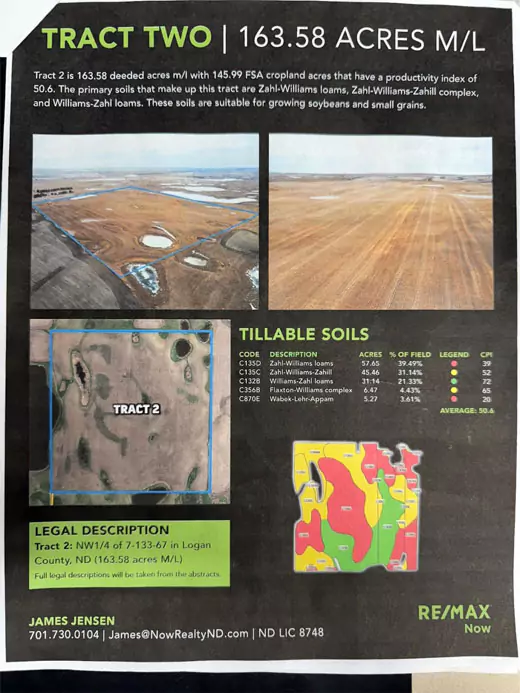
If you are looking for an exceptional agricultural investment opportunity, Tract 2 in Logan County, North Dakota, provides that. Featuring 163.58 deeded acres m/l, the tract offers a blend of good soil and productive farm ground. The tract comprises 145.99 FSA cropland acres, presenting ample opportunities for farm operations. Whether you’re a seasoned farmer or an investor looking for excellent agricultural land to produce any crop, Tract 2 presents a great platform to cultivate your crops.

Highlights of Tract 2

Tract 2 is situated in the NW 1/4 of 7-133-67 in Logan County, ND, an area renowned for its agricultural suitability. With its spacious 163.58 deeded acres, this property has space and flexibility for farming activities. The tract mainly comprises quality FSA cropland acres and 145.99 acres of productive farmland.

Highlights of Tract 2

The tract’s productivity index of 50 represents a strong grade that suggests soils on Tract 2 are highly productive and can grow various crops. That makes the tract well-suited for the growth of crops like soybeans and small grains—the two most frequent and lucrative crops in the area. If you want to increase your agriculture business or need land to plant crops, Tract 2 presents the perfect opportunity.

The Soils of Tract 2: Optimal for Crop Production

Soils constituting Tract 2 are the primary contributors to the land’s agricultural capability. The property combines three primary soils: Zahl Williams loams, Zahl Williams-Zahll complex, and Williams Zahl loams. These are very fertile and suitable for all types of crops.

  • Zahl Williams loams are well-drained, rich soils that offer the perfect conditions for crop production, such as soybeans, corn, and small grains. The soils are well-balanced in moisture holding, enabling stable yields and robust crop development.
  • Zahl Williams-Zahll complex combines Zahl Williams loams and other complementing soils. The complex soil type has excellent drainage, retention of nutrients, and a stable condition for the growth of crops.
  • Williams Zahl loams are also very fertile soil on Tract 2. Similar to the Zahl Williams loams, they also have good water retention and fertility, which allows them to support the cultivation of a wide range of crops, such as soybeans and small grains.

These soil types collectively make Tract 2 an excellent property for crop production. Whether you want to grow soybeans, barley, or wheat, these soils offer the right conditions for success. Additionally, the productivity index 50 reinforces that this tract is well-suited for farming, offering the potential for strong and consistent yields year after year.

Agricultural Potential

Agricultural Potential: Soybeans and Small Grains

Given the integration of rich soils and the desirable productivity index, Tract 2 is ideally suited to planting soybeans and small grains. Soybeans are among the highest-valued crops to grow in North Dakota, and this land is well-equipped to carry them. Loamy soils create perfect drainage for the soybeans, allowing the crops to establish firm roots and enough moisture for a top crop.

In combination with soybeans, small grains like wheat, oats, and barley grow exceptionally well in the soil conditions on Tract 2. These are staple crops in the area, with North Dakota being a significant producer of small grains in the U.S. due to the moisture-retention qualities of the soils and their ability to deliver copious nutrients for small grains.

With the purchase of Tract 2, you can take advantage of North Dakota’s robust agricultural economy. The fact that it has fertile soil, a good productivity index, and favorable conditions for soybean and small grain growth makes this tract a good investment for anyone who wants to get the most out of farming.

Location: Logan County, North Dakota

Tract 2 is situated in Logan County, ND, an area characterized by its thriving farming community. The county’s rich soil, in addition to its good climate, presents a perfect setting for crop production. Logan County is strategically placed within the larger farm belt of North Dakota, presenting an ideal option for an individual who desires to invest in agricultural land or grow their farming business.

The tract is located in the NW 1/4 of 7-133-67 in Logan County, North Dakota, an area that has enjoyed consistent success in agricultural production. With access to major transportation corridors and a local farming community that supports agriculture, Tract 2 provides both short-term and long-term value for farmers and investors.

Legal Description and Title

If you’re looking to invest in Tract 2 in Logan County, the Abstracts of McIntosh County can assist with all your title services and closing real estate Logan needs. Abstracts of McIntosh County, one of the leading title companies in Logan County, is giving a precise and detailed description of the property’s boundaries and ownership. This way, the property is described correctly, and all legal documents are accurate, giving you peace of mind when investing.

Our experienced team ensures that your transaction runs smoothly, providing clear and accurate title work, including a thorough review of property documents. At Abstracts of McIntosh County, we have close working relationships with legal professionals to ensure that the transfer of the deed and any filings are processed efficiently.

Why Invest in Tract 2

Why Invest in Tract 2?

If you want to expand your agricultural operations or add to your portfolio, Tract 2 offers a prime investment opportunity. With 163.58 deeded acres m/l of land, a productivity index 50, and 145.99 FSA cropland acres, this tract is well-positioned for growing soybeans, small grains, and other crops. The rich soil composition, including Zahl Williams loams, the Zahl Williams-Zahll complex, and Williams Zahl loams, makes it a reliable and productive investment.

Investing in farmland, such as Tract 2, has short- and long-term advantages. With the demand for agricultural products and food likely to increase, farmland is an enduring asset that will continue to offer returns over time. Whether you intend to cultivate the land yourself or sublease it to other farmers, Tract 2 provides a variety of possibilities.

For those looking to purchase fertile and high-potential agricultural land in North Dakota, Tract 2 in Logan County will be the best option. With almost 164 acres of land, a productivity index of 50, and soils suitable for cultivating soybeans and small grains, the tract will provide a reasonable basis for agricultural operations. Please make the most of this excellent opportunity and call “Abstracts of McIntosh County” now to learn more about Tract 2. Whether you are a seasoned farmer or an investor who wants to increase the size of your holdings, this land is ideal for your farming requirements.

Top Benefits of Working with a Reliable Title Insurance Company

It’s understandable that when involved in a real estate transaction-whether you are buying, selling, or refinancing-your mind becomes focused on the joy of finding the perfect property or closing the sale. However, there is one important aspect that requires careful consideration: title insurance. Title insurance stands between you and the possible legal claims that may arise after closing the property transaction down. Being with a trustworthy title insurance company like Abstracts of McIntosh County, Inc. is the additional layer of protection for your investment and your future.

Working with a trusted title insurance company such as Abstracts of McIntosh County, Inc. will serve to give you peace of mind and provide great benefit in your real estate transaction.

1. Complete Protection From Title Problems

One major advantage of title insurance is that it secures an insured against title flaws which may not be immediately obvious; often, in closing, searches for a title are done to see what problems there may be with ownership, such as unknown unpaid taxes, liens, or unresolved disputes. However thorough a title search, there cannot be a guarantee that every possible risk is identified.

Thus, buy title insurance through an appropriate company like Abstracts of McIntosh County, Inc. You will be justly patrolling such hidden defects that do not show up until after closing, such as:

  • Fraudulent signatures: If another person fraudulently provided a previous owner’s signature, you can be challenged legally for ownership.
  • Undiscovered heirs: Some unknown relative of the seller may suddenly appear and demand ownership of the property, which might complicate your legal position.
  • Unpaid liens or mortgages: If the prior owner failed to settle their debts, including unpaid mortgages or home equity lines, these monetary claims may be attached to the property, compromising your rights to ownership.

Title insurance shields you from financial loss and the hassle of having to deal with these problems once the transaction is finalized. Abstracts of McIntosh County, Inc. guarantees that your title insurance policy insures against these risks, so you don’t have to worry about expensive surprises later on.

2. Peace of Mind for Both Buyers and Lenders

Buying real estate is a significant financial investment, and both the buyer and lender are at risk if there is a problem with the title to the property. For the buyer, the last thing you want to find out months or years later is that someone else has a claim to the property you have just bought. For the lender, title flaws can render the property unencumbered, resulting in financial loss.

By using a trusted title insurance provider such as Abstracts of McIntosh County, Inc., you can be sure that you and your lender are safeguarded against future title-related hazards. Buyers can move into their new home with peace of mind, knowing that any previous ownership problems have been cleared up or insured against. Similarly, lenders are safeguarded, and their investment is secure in the event of a title dispute.

3. One-Time Premium Payment for Financial Security

In contrast to other forms of insurance, title insurance involves a one-time premium payment at closing. This single payment gives lifetime protection to you, provided you or your heirs retain ownership of the property. The reason you don’t have to concern yourself with periodic premiums or renewals is that title insurance is an inexpensive and sensible means of protecting your investment.

By dealing with Abstracts of McIntosh County, Inc., you can be certain that you are receiving a fair and competitive price for your title insurance. We give you transparent explanations of the costs incurred so you always know what you’re paying for and the amount of coverage you are getting.

4. Professional Support with Title Searches and Documentation

One of the most important jobs of a title insurance company is to perform a diligent title search to confirm that no one has any pending legal matters that pertain to the property. Abstracts of McIntosh County, Inc. possesses the talent and tools to perform this important step accurately. Our experts are well qualified to examine public records, including tax assessments, deeds, and court records, in order to spot any possible defects in the title of the property.

Our diligence and in-depth understanding of real estate law and county records guarantee that we find any potential problems that may complicate your transaction. It might be an unpaid lien, boundary issue, or an unsettled legal problem from past owners, but we’ll make sure you know precisely what you’re purchasing. This serves to reduce the likelihood of surprises arising once the transaction has been finalized, allowing for a smoother and quicker closing process.

5. Speedy and Streamlined Closings

A good title insurance firm can also have a major influence on your closing time. At Abstracts of McIntosh County, Inc., we make every effort to make sure your title search happens quickly and that the required documents are handled promptly. A quick and precise title search ensures any issues that may arise with the title are detected early and resolved quickly.

Our streamlined process not only facilitates transactions more efficiently but also limits the opportunity to experience unforeseen delays from lost or incomplete paperwork. For this reason, you can be confident that your closing will occur on schedule so that you can proceed with your new home without undue delays.

6. Clear Communication and Personalized Service

At Abstracts of McIntosh County, Inc., we take pride in providing individualized service and effective communication. Real estate transactions are often complicated, but we’re there to walk you through every step of the title insurance process. From breaking down the specifics of your title insurance policy to fielding all your questions regarding the closing process, our professionals are on hand to offer support where you need it.

We invest the time to walk you through the details of your title search and title insurance so you know what your coverage entails and what you need to do next. Our dedication to clear communication and customer satisfaction is unmatched in the title insurance industry.

7. A Trusted Partner with Local Expertise

Selecting a title insurance firm that has local experience is crucial in order to have your real estate transaction go smoothly. Abstracts of McIntosh County, Inc. is entrenched in the local community and has extensive knowledge of properties in McIntosh County and the surrounding region. Our staff understands the local real estate market, county laws, and records of properties in the area, which provides an advantage in finding potential title concerns and providing you with solutions relevant to your specific property location.

Our extensive knowledge of local statutes and property history allows us to offer customized solutions that best safeguard your interests, making us your best partner in your real estate transactions. With our detail-oriented staff, expertise, and dedication to customer satisfaction, we’re here to walk you through each stage of the title insurance process.

Don’t let title problems put your real estate transaction at risk—work with Abstracts of McIntosh County, Inc. today to make sure your investment is fully protected.